How to Brew Phoenix Dancong Tea
10月 15, 2026
The Beauty of a Cup of Chinese Tea
10月 15, 2026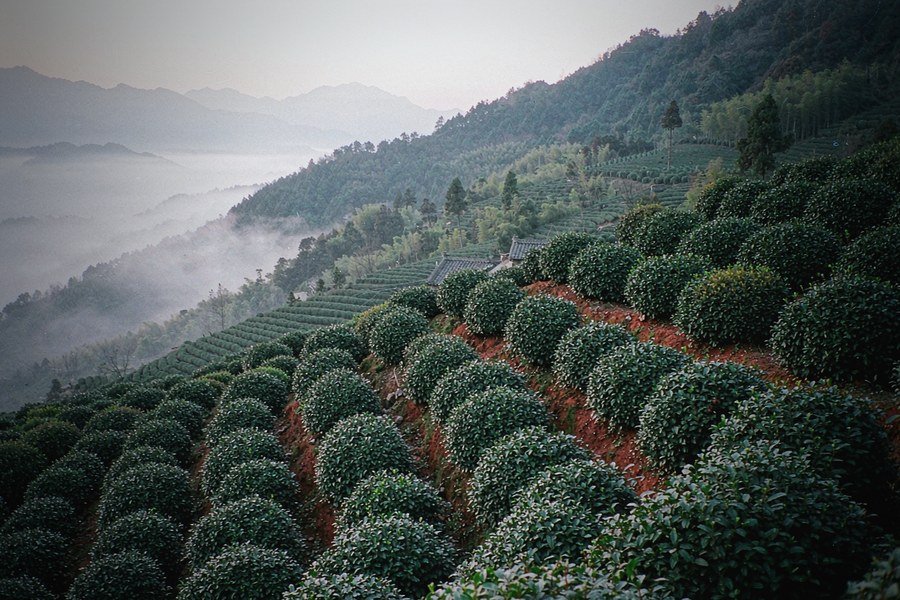
Phoenix Mountain — Fenghuang Shan in Chinese — rises out of Chaozhou in eastern Guangdong, less than fifty kilometres from the Fujian border. It is the only place in the world that produces Phoenix Dancong, and the reason the tea tastes the way it does is mostly geography.
Where Phoenix Mountain Is
The mountain sits at roughly 23.5° north, just inside the Tropic of Cancer, in a coastal province that is hot for most of the year. The main tea gardens run from about 600 metres to over 1,200 metres above sea level, with the highest plots on Wudong and Daping villages.
The growing area is small and fragmented. Instead of one continuous plantation, the tea grows in pockets on slopes and in valleys, separated by forest and granite outcrops. That fragmentation matters: it is one of the reasons single-village and single-tree teas from the mountain taste noticeably different from one another.
What the Mountain Puts in the Leaf
- Mist. Cloud sits on the slopes for much of the year, cutting direct sun and slowing the leaf’s growth. Slower growth means thicker leaf and higher concentrations of the aroma compounds Dancong is famous for.
- Large day-to-night temperature swings. Warm days build sugars; cool nights slow respiration and keep them in the leaf.
- Weathered granite soil. The mountain’s bedrock breaks down into a sandy, well-drained, slightly acidic soil with plenty of mineral content. Tea roots do not like standing water, and here they never get any.
- Altitude. The best-known gardens sit above the fog line for part of the day, which lengthens the growing season and concentrates flavour.
How much of that is measurable and how much is folklore is a live question — but the same set of conditions shows up wherever high-aroma tea is grown, from Phoenix Mountain to the highlands of Taiwan and Sri Lanka. The Tea Research Association is one of the oldest bodies working on the agronomy behind it.
Nine Hundred Years of a Name
Tea has been grown on Phoenix Mountain for the better part of a millennium. Local accounts trace the first plantings to the Song dynasty, and by the Ming and Qing periods the mountain was already known for individual trees producing distinctive aromas rather than for a single uniform product.
The modern reputation was consolidated in the twentieth century, when a small number of outstanding old trees were selected, named and propagated. Many of those original trees are still alive and still picked, and their names — Mi Lan Xiang, Zhi Lan Xiang, Ya Shi Xiang — are now the names of whole aroma types grown from their cuttings.
What “Dancong” Actually Means
Dan means single, cong means bush or clump. Phoenix Dancong is literally single-bush tea: leaf taken from one selected tree, processed on its own, and sold under that tree’s name.
In practice most Dancong on the market today comes from cuttings of those named mother trees rather than from the original trees themselves, and is processed in small batches by aroma type. The principle still holds, though: the tea is defined by which tree it came from, not by a grade or a garden size.
The Aroma Families of Phoenix Mountain
Ten aroma types are conventionally recognised. These four are the ones most often exported, and the ones to learn first.
| Aroma type | Name in Chinese | Character in the cup |
|---|---|---|
| Honey Orchid | Mi Lan Xiang (蜜兰香) | Honeyed and floral, smooth and rounded, the most approachable of the group |
| Orchid | Zhi Lan Xiang (芝兰香) | Elegant orchid fragrance, refined and long-lasting, less sweet than Mi Lan |
| Silver Flower / Duck Shit | Ya Shi Xiang (鸭屎香) | Bright, distinctive floral top note with a lingering finish |
| Ginger Flower | Jiang Hua Xiang (姜花香) | Spicy-floral, sharper and more assertive, a favourite among experienced drinkers |
Students of the mountain argue about the rest of the list the way winegrowers argue about appellations. For a drinker, the useful takeaway is that “Phoenix Dancong” on a label tells you where the tea is from, while the aroma name tells you what it will actually taste like.
One Harvest, Two Seasons
The main crop is picked in spring, from late March through April, with the finest leaf taken before the Qingming festival. Spring leaf is slower to grow and carries the most aroma.
A second, smaller harvest comes in late autumn and early winter, sometimes called “snow” tea. It is lighter and more delicate, and much less widely available. Summer leaf is rarely sold as premium Dancong.
Picking is still done by hand. Pickers take a shoot and two or three leaves, working across the slope through the morning and stopping when the sun is high.
Phoenix Dancong is a small part of a very large global trade. The FAO’s commodity overview of tea tracks production and prices worldwide, and it is a useful counterweight to the romance of the mountain.
From Fresh Leaf to Finished Tea
- Sun withering (shai qing). Fresh leaf is spread thin outdoors in the late afternoon to lose moisture and begin the aromatic changes.
- Cooling (liang qing). The leaf is brought inside and rested, so that moisture equalises through the leaf before bruising begins.
- Bruising / turning (zuo qing). The defining step of oolong. Leaf is shaken in bamboo drums and rested repeatedly over several hours. The bruised edges begin to oxidise while the centre of the leaf stays green — the source of the “green leaf with a red edge” you see in a finished Dancong.
- Fixing (sha qing). Heat stops oxidation at the right moment. Getting this moment wrong is what separates a floral tea from a flat one.
- Rolling (rou nian). The leaf is twisted into the long strips that give Dancong its shape.
- Roasting (bei huo). Slow baking over charcoal or in a heated drum, often repeated over days or weeks, drives off the last moisture and locks in the aroma.
Tasting the Mountain in a Cup
A good Phoenix Dancong should smell better than it tastes at first, and taste better than it smells by the third infusion. Look for a long finish, a clean texture and an aroma that changes as the cup cools — that last detail is the clearest sign that the leaf really came off a mountain rather than a factory floor.
Our Phoenix Dancong range is picked on Phoenix Mountain and processed in small batches by aroma type. To learn how to get the most out of it, read our brewing guide.
Working in tea wholesale, private label or gifting? We would like to hear from you.
For a wider view of where single-origin Chinese tea sits in the global market, World Tea News and Tea & Coffee Trade Journal both cover the trade from the buyer’s side.